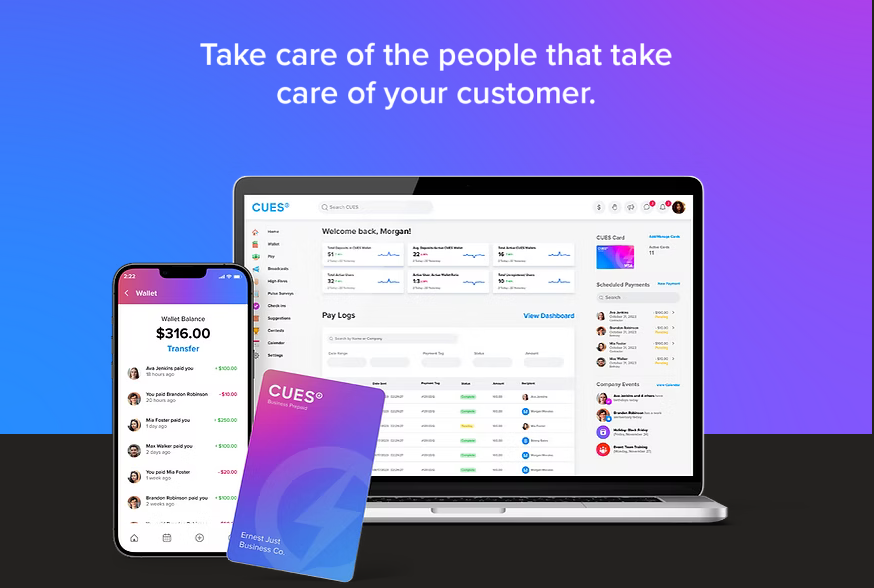
CUESMobile wallet · card · dashboard
CUES gives a business instant payment rails to its own team — stipends, bonuses, spiffs, reimbursements and tips paid out on the shift instead of on the bank's cycle — with a prepaid card and a cashback layer on top.
The people closest to the customer are the slowest to get paid. A bartender earns a spiff on Friday and sees it in a fortnight. A technician buys a part out of pocket and files an expense report that clears at the end of the month. A manager wants to reward a shift that went well and has no mechanism faster than payroll.
Everything about that gap is a business problem: the incentive stops motivating by the time it lands, the expense admin costs more than the expense, and the team's sense of being looked after erodes on the delay rather than the amount.
Money moves between the business and the person immediately, and between people in the app. A spiff paid at the end of the shift is in the wallet at the end of the shift — no bank cycle, no payroll run, no waiting.
A business prepaid card that removes the reimbursement loop entirely. Staff spend from the card instead of their own pocket, so there is no expense report to file and no float to chase.
The more payouts run through the platform, the more the user earns back — a rewards layer that makes the fast rail the one everybody wants to use.
Broadcasts, high-fives and pulse checks sit next to the wallet, so an incentive is announced, earned and paid in the same place instead of across a group chat, a spreadsheet and a payslip.
One system, two very different jobs.
A payments product earns trust in the first ten seconds of use or never.
A transfer that resolves while the user is still looking at the screen is the entire promise. Everything else in the product is built around not breaking it.
Spend on the card, transfers between people and payouts from the business all read against the same balance, so nobody has to reconcile two figures in their head.
The people being paid are standing up, mid-service, on a phone. The primary experience is native on iOS and Android; the dashboard is the secondary surface, not the other way round.
Shipping to businesses paying distributed and frontline teams.
Payments products are unforgiving — the trust is won or lost in the first transfer. If that is the problem in front of you, it is the kind we like.